Managing a real estate business involves much more than listing properties and closing deals. Teams need to track inquiries, coordinate site visits, maintain property records, manage lease and sales agreements, monitor payments, and respond to tenant requests. When these activities are handled through separate spreadsheets and applications, important information can become difficult to track.
For growing real estate companies, disconnected processes can slow down sales, delay follow-ups, and limit visibility into property performance. Odoo for real estate offers a flexible ERP foundation that connects customer management, sales, property-related workflows, accounting, and reporting within a single coordinated system.
ERP Consulting Group helps businesses assess their operational requirements and configure Odoo around their processes, providing customization and integrations where needed. The objective is to reduce information gaps and give teams a clearer view of their day-to-day operations.
Why Do Real Estate Companies Need Odoo ERP?
Real estate businesses manage several interconnected workflows. A property inquiry may lead to a site visit, a sales negotiation, an agreement, an invoice, and ongoing customer service. If each stage is recorded in a different system, employees may need to enter the same information repeatedly or search through messages to understand the latest status.
Common challenges include:
- Scattered Property Information: Listings, ownership details, availability, photographs, and documents are maintained in separate files.
- Missed Sales Follow-Ups: Inquiries from websites, portals, referrals, and advertising campaigns often lack clear ownership or next actions.
- Limited Financial Visibility: Booking amounts, outstanding payments, rental income, expenses, and commissions can be difficult to reconcile.
- Manual Coordination: Sales, property management, finance, and maintenance teams frequently work with different versions of the same information.
A connected real estate ERP software setup can bring these activities into a more consistent workflow. For a broader perspective, read our guide on how real estate firms use Odoo ERP to reduce operational gaps and close deals faster.
Key Features of Odoo for Real Estate
The right configuration depends on whether a business focuses on property sales, rentals, brokerage, property management, or a combination of these activities. Odoo's standard applications support several operational requirements, while property-specific workflows may require tailored configurations, customizations, or third-party integrations.
1. Property Management and Centralized Records
An effective Odoo property management workflow requires reliable information about every unit or property. Relevant records include property specifications, photographs, location, availability, ownership details, pricing, documents, and maintenance history.
With a properly designed system, teams maintain structured property records connected to related customer inquiries, transactions, and service activities. When a property's status changes, the relevant teams update the master record instead of relying on separate spreadsheets.
For example, a property marked as reserved should not continue to appear as freely available in internal sales tracking. A clear status workflow helps reduce confusion between sales representatives and property managers.
Businesses that need workflows for property stages, rental and lease management, agreements, and maintenance can explore our real estate management solution.
2. Real Estate CRM Software for Lead Management
Real estate CRM software helps teams organize inquiries, maintain customer history, assign responsibilities, and plan follow-ups. This becomes especially important when leads arrive through multiple channels, including property portals, websites, advertising campaigns, referrals, and phone calls.
A structured lead management process captures relevant information such as the customer's budget, preferred location, property type, purchase or rental requirements, and next follow-up date.
A typical workflow follows this progression:
Inquiry → Qualification → Property Matching → Site Visit → Negotiation → Booking or Agreement
At each stage, the responsible salesperson can identify the current status and next action. Managers can also easily review which inquiries are progressing and which opportunities need attention.
For more detail, read our guide to real estate lead management for property portal enquiries.
3. Lease and Sales Agreement Tracking
Property transactions involve multiple documents, approvals, dates, and payment milestones. A disconnected process makes it difficult to identify which agreements are pending, which documents are missing, or when a renewal needs attention.
An appropriately configured Odoo workflow links relevant documents and activities directly to the customer, property, and transaction record. Teams can track agreement statuses, important dates, pending actions, and related financial entries.
Automated reminders and approval steps can be configured according to your specific business requirements. (Note: Legal document preparation, electronic signatures, and jurisdiction-specific requirements should be assessed separately to determine whether additional tools or integrations are necessary.)
4. Financial Management and Accounting
Property transactions affect several financial activities, including booking payments, rental receipts, security deposits, expenses, commissions, invoices, and outstanding balances.
Connecting financial workflows with customer and transaction records helps teams understand what has been billed, what has been received, and what remains outstanding. Accounting reports also support the comprehensive review of revenue, expenses, and overall business performance.
For brokerages, the workflow may additionally involve calculating commissions and tracking receivables or agent payouts against individual deals. Our article on real estate brokerage software and the lead-to-commission workflow explores this operational requirement in more detail.
5. Marketing and Website Integration
Real estate businesses rely heavily on website inquiries, property listings, landing pages, and digital campaigns to generate leads. If marketing activity is disconnected from the sales process, teams struggle to identify lead sources or measure how effectively leads are handled.
Odoo's website and CRM capabilities support connected lead-generation workflows. Website forms link directly to the lead pipeline, while source tracking and reporting help teams review inquiry volume and follow-up performance.
The aim is to create a clear connection between marketing activity and sales outcomes rather than managing every inquiry in isolation.
6. Tenant and Customer Management
The customer relationship does not end when a property is sold or leased. Tenants may need maintenance assistance, payment clarifications, renewal reminders, or updates regarding their properties.
A connected customer record gives teams immediate access to relevant communication history, agreements, payment information, and service requests. Depending on your setup, service activities can be assigned to responsible employees and tracked through to resolution.
This gives property managers an organized way to handle requests, reducing dependence on individual email inboxes or message histories.
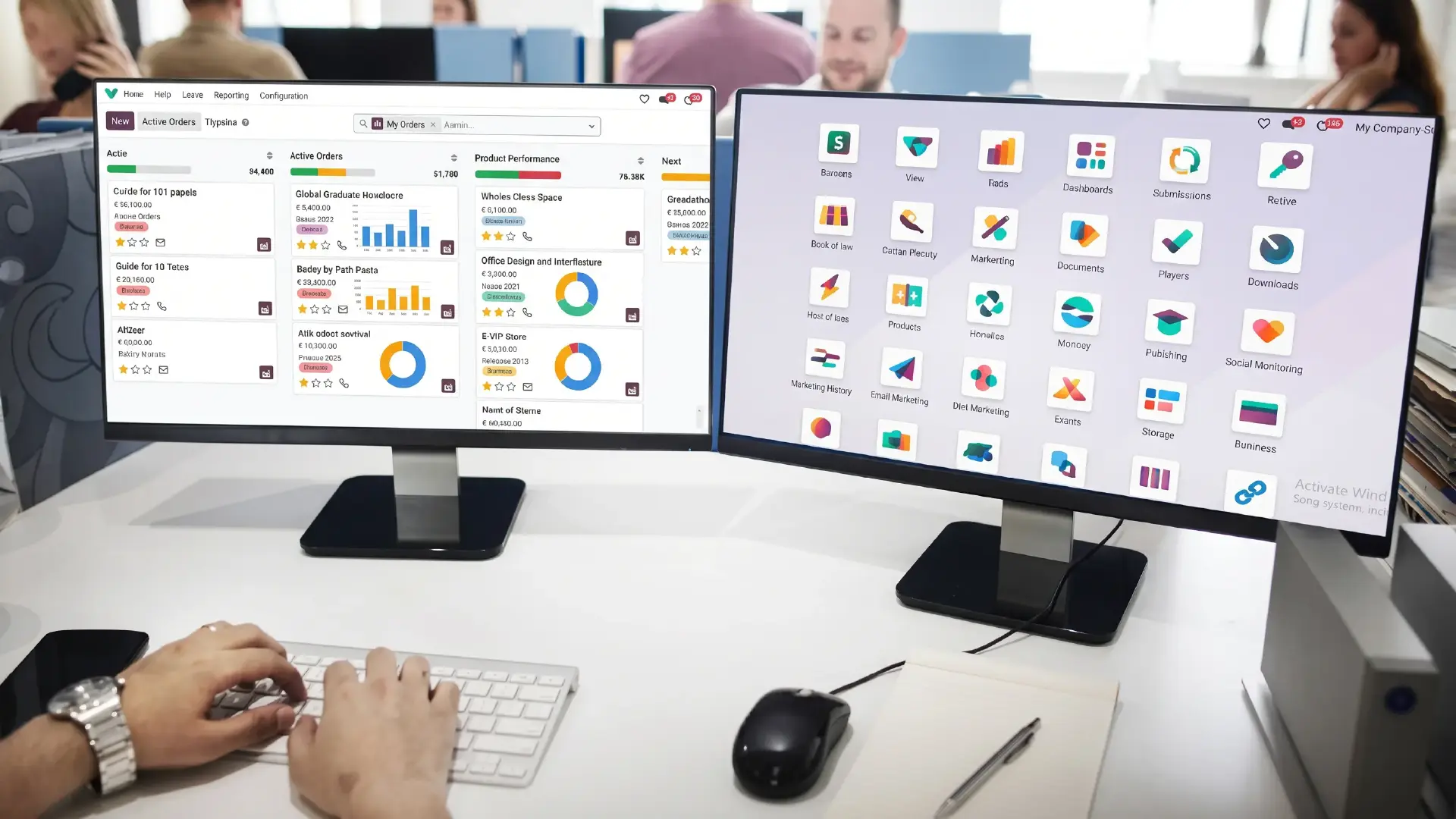
- Centralized Information: A connected system eliminates the need to search through multiple files to understand a property, customer, transaction, or outstanding task. Teams work from consistent records based on their access permissions.
- Customization and Scalability: Real estate businesses differ in how they handle sales, rentals, brokerage, and maintenance. Odoo can be configured to match these exact workflows, with customization or integrations where standard features fall short.
- Better Operational Visibility: Managers can use structured records and reports to review lead stages, property availability, pending agreements, outstanding payments, and service activities.
- Improved Customer Experience: When customer requirements, communication history, and pending actions are readily accessible, teams respond more consistently and quickly.
- More Informed Decision-Making: Connected operational and financial data helps management evaluate business activity, identify recurring delays, and decide where process improvements are needed.
Real Estate Management Software: What Should You Compare?
Before selecting or configuring real estate management software, identify which workflows need to be connected and which capabilities are essential for your business.
Business Requirement | Key Operational Metrics & Features to Track |
Property Management | Property records, availability status, documents, and maintenance history |
Lead Management | Lead sources, ownership, follow-up dates, and sales pipeline stages |
Agreements | Document statuses, key renewal dates, approvals, and pending actions |
Financial Management | Invoices, receipts, outstanding balances, commissions, and expenses |
Tenant Management | Customer history, maintenance service requests, and lease renewals |
Reporting & Analytics | Sales pipeline performance, property availability, financial position, and pending tasks |
The right solution should fit your operating model. A brokerage may prioritize lead allocation and commission tracking, while a property management company will focus more on leases, recurring billing, maintenance, and tenant communication.
How to Configure Odoo for Your Real Estate Business
A successful implementation begins with business processes rather than a list of software features.
Start by mapping how inquiries enter the business, how properties are assigned, how site visits are arranged, how agreements are approved, and how payments are recorded. Next, identify which Odoo applications can support these steps and where configuration, customization, or integration is required.
Data migration, user permissions, reporting requirements, and employee training should also be planned prior to deployment. Testing these workflows with realistic business scenarios will help identify operational gaps before teams begin using the new system.
For a more detailed explanation, read our guide on configuring Odoo ERP for real estate lead and sales management.
Executive Summary
- Connect Property Operations: Unify property, customer, agreement, and service information into coordinated workflows.
- Improve Lead & Financial Visibility: Track inquiry ownership, sales progress, payment receipts, and outstanding tasks consistently.
- Configure Around Business Needs: Maximize standard Odoo capabilities first, then layer on necessary customizations and integrations.
Frequently Asked Questions
Is Odoo suitable for real estate companies?
Yes. Odoo provides a solid foundation for CRM, sales, accounting, website management, and broader operational workflows. Real estate-specific requirements can be tailored through configuration, custom development, or integrations depending on your business model.
Can Odoo be used as real estate CRM software?
Yes. Odoo CRM supports lead capture, opportunity tracking, sales activities, and follow-ups. Property-specific fields, allocation rules, and custom pipelines can be configured to match your sales process.
Can Odoo manage property leases and rental payments?
Odoo supports customer records, document management, invoicing, and accounting workflows. Specific lease lifecycles, recurring billing rules, renewal reminders, and property management functions can be set up during implementation via standard apps or tailored modules.
How do we choose the right real estate ERP software?
Begin by documenting your current processes and identifying where information is lost, duplicated, or delayed. Compare solutions based on property tracking, CRM features, agreement workflows, accounting, maintenance tools, reporting, and implementation support not just listed features.
Ready to Streamline Your Real Estate Operations with Odoo?
Managing property listings, enquiries, agreements, finances, and maintenance across disconnected tools can make it difficult to maintain visibility as your business grows. ERP Consulting Group helps real estate businesses assess their workflows and determine how Odoo can be configured, customized, and integrated to meet their operational requirements. Contact ERP Consulting Group at info@erpconsulting24.com to discuss an Odoo solution for your real estate business. Explore our Real Estate Industry Solution to learn more about our approach. |

 Recent Posts



 Free Consultation